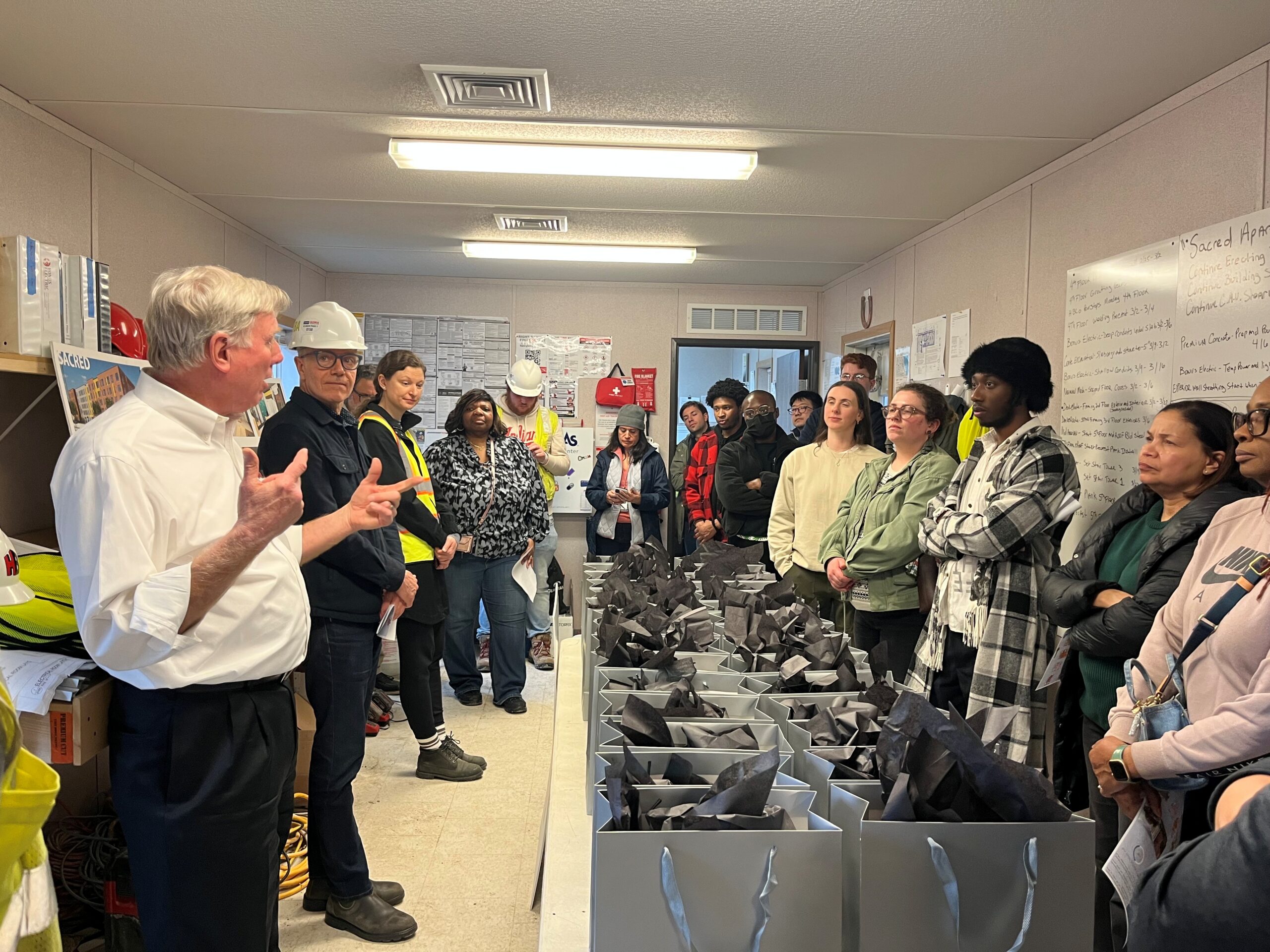
Henry Bros. Co. (HBCo) recently hosted a group of adult students from the Chicago Rehab Network’s Community Empowerment Workshop Series at its construction site for SACRED, a new five-story, 104,681-square-foot apartment building that will include 81 residential units, retail space, and supportive services.
Students in the Project and Construction Management class toured the active jobsite to gain insight into how large development projects move from planning to construction.
William H. Callaghan Jr., owner and president of HBCo, welcomed the group and shared an overview of the company’s 105-year history. He also explained the extensive planning that takes place before construction begins, noting that the project’s preconstruction team—including the owner, design team, and HBCo—met for three years before any site work started at SACRED.
“Preconstruction meetings allow for design review, budget analysis, bidding plans, and scheduling,” said Callaghan. “We also develop comprehensive jobsite and worker safety plans for every HBCo project.”
SACRED, 9212 South Burley Avenue, is expected to help support the revitalization of South Chicago. The development team includes Interfaith Housing Development Corporation (IHDC) and Claretian Associates, with architecture by LBBA Ltd.
“We were happy to host this group at our site,” said HBCo Project Manager Shannon Erickson. “SACRED is one of more than 20 multi-unit housing projects we’ve completed in the past decade. As general contractor, we’re proud to help deliver quality, affordable housing for communities across the Chicago area.”
Angela Hurlock, CEO of Claretian Associates, who teaches the two-day Project and Construction Management course on a pro bono basis, coordinated the site tour with Henry Bros. Co.
The course is one of eight offered by the Chicago Rehab Network to community members seeking to improve the quality of life in their neighborhoods. Participants come from a wide range of organizations, including local banks, churches, development partners, and public agencies such as IHDA, CHA, DPD, and DOH.


